Before I draft a single headline, I'm buried in instructions for use, FTC guidance, patient reviews, and whatever the competitor down the street is promising. That's the part of medical copywriting nobody sees... and the part most lists of medical copywriting tips skip on their way to headlines and buttons.
Skip it yourself and you end up with a wound care homepage that says "Faster healing, GUARANTEED!" in big bold letters. Then a skeptical patient (or a regulator with a free afternoon) asks "Says who?" and the page has nothing to say back.
That page failed weeks before anyone typed it, back when nobody did the reading, highlighting why medical healthcare copywriting services must prioritize thorough research before the writing begins.
TL;DR Quick Answers
Medical Copywriting Tips
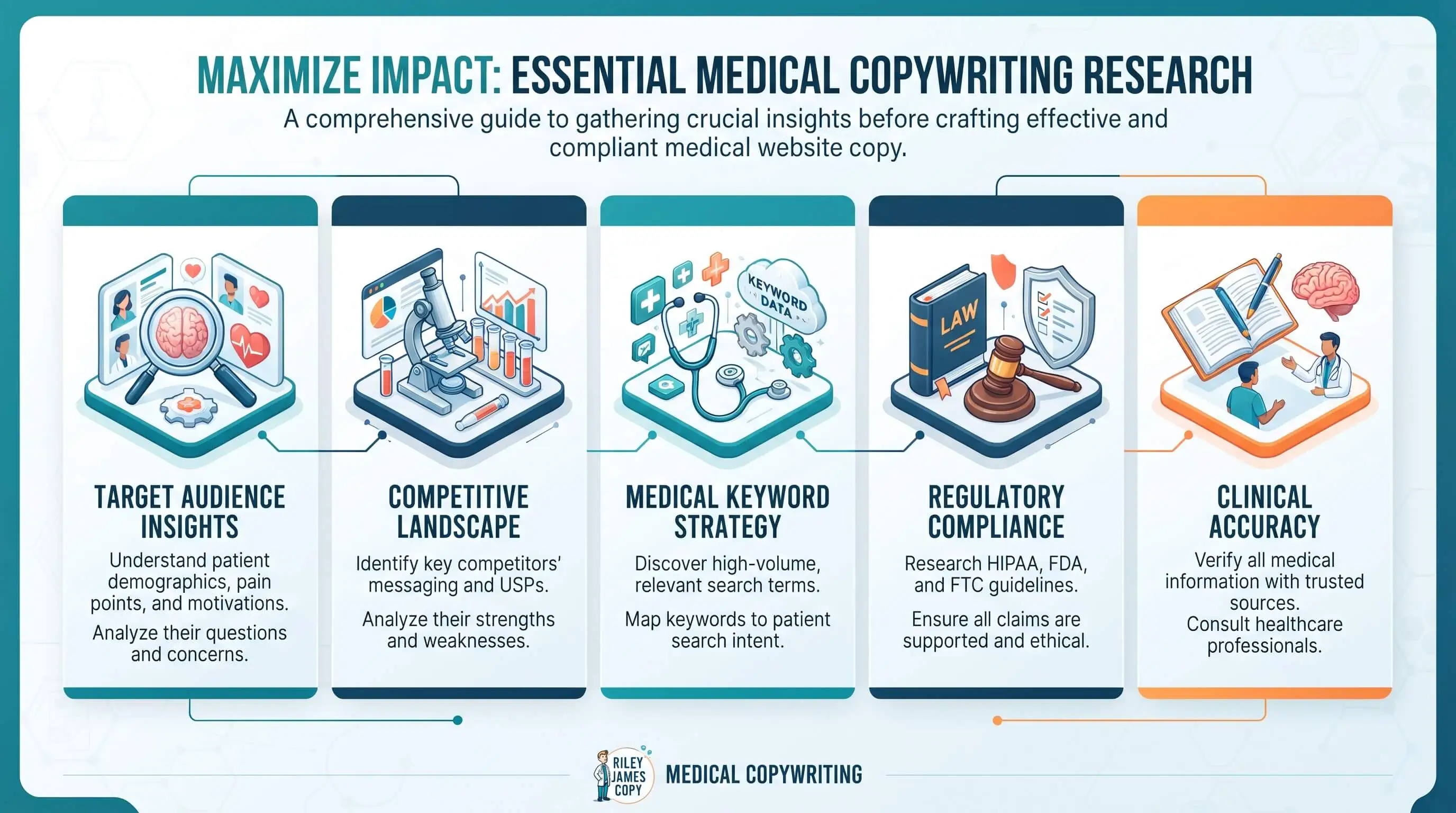
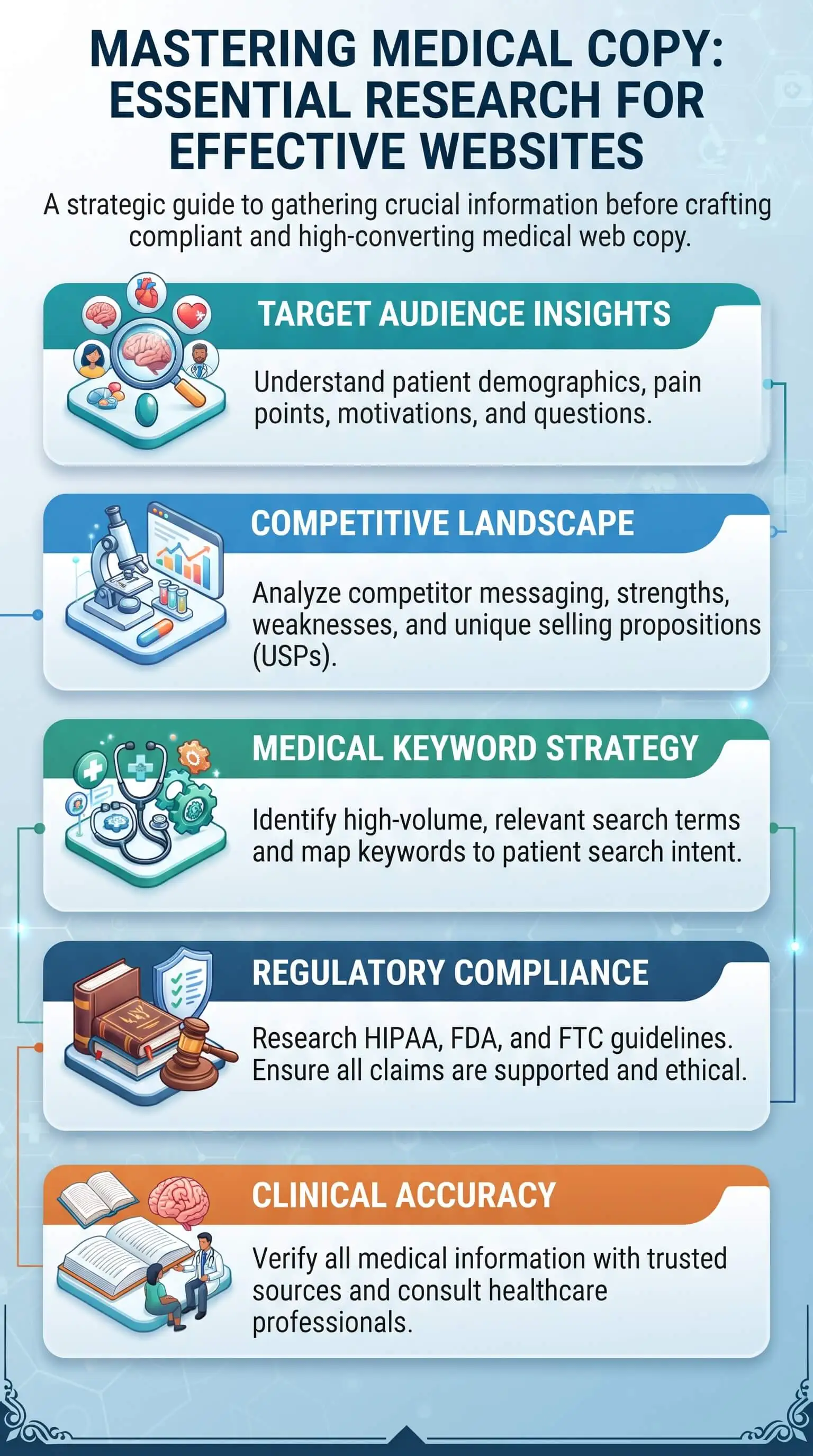
The best medical copywriting tips kick in before you write a word. Accurate, persuasive healthcare copy comes from research first and wording second:
Know the reader. A worried patient and a bulk buyer need different words, even for the same product.
Learn what the product can't do. Its limits keep your claims honest.
Check the rules. The FTC covers health claims, the FDA covers product labeling, and HIPAA covers patient stories.
Cite named sources. Use government agencies and peer-reviewed research, and never write "studies show."
Use patients' search words. People type "gauze stuck to wound," not clinical jargon.
Lead with the patient's question. Then earn the right to mention your credentials.
One rule carries the rest: if you can't trace a claim back to a credible source, it stays off the page.
Top Takeaways
Research the reader first. A worried caregiver and a bulk buyer need different pages, even for the same gauze dressing.
Learn what the product can't do. Its limits matter as much as its benefits, and they keep your claims honest.
Know the rules before you write a claim. The FTC covers truthful advertising, the FDA covers product labeling, and HIPAA covers patient stories.
Trust sources in the right order. Government agencies and peer-reviewed research come first. Forums are only for patient language.
Find out how patients search. Their words decide whether the page gets found, not your clinical terms.
Inventory proof you can verify. Anything you can't back up stays off the page.
Why Does Research Come Before the First Draft?
Because in healthcare, a wrong word costs a lot more than a boring one.
Copywriting is sales writing, and its whole job is to get someone to act. Exaggerate a little in most industries and the page just sounds cheesy. Exaggerate in medicine and you can steer a reader toward the wrong treatment, break a federal rule, or sink a practice's credibility in one sentence.
You can only say something boldly once you KNOW it's true. That's what research buys you.
1. Who Is Actually Reading the Page?
Start with the reader, before you even think about the topic. The same subject reads completely differently depending on who's on the other side of the screen.
Patients and Caregivers
They're usually searching in the middle of the problem, often worried and sometimes hurting. Plenty of them struggle with health information even on a calm Tuesday. Give them plain words and one obvious next step.
Clinicians, Buyers, and Referral Partners
These readers want specifics like indications, evidence, sizes, and ordering details. Simplify too much and you'll lose them by the second paragraph.
Gauze dressings make a good example. A daughter changing her dad's dressing at home wants to know how often to swap it and when to call the doctor. A home health agency buying gauze by the case cares about absorbency, sterility, and price per unit. You'd write those two pages very differently, even though the product in the box is identical.
Where I look for the reader: front-desk FAQs, nurse call notes, patient reviews, support emails, and online forums. Forums are gold for the words people actually use... and terrible for facts.
2. What Does the Condition, Treatment, or Product Really Do?
Learn the thing before you sell the thing. I read the instructions for use, the spec sheets, and any clinical summaries before I open a single marketing brochure.
Then I talk to someone who handles it every day, like a wound care nurse or the product manager. My favorite question for them is simple: "What do patients get wrong?"
Write down what the product doesn't do just as carefully as what it does. A standard gauze pad and a hemostatic dressing built for heavy bleeding are NOT interchangeable, and a copy that blurs that line is making a claim it can't back up.
3. Which Rules Govern What the Page Can Claim?
Amateurs skip this step. Unfortunately, it's also the one that bites the hardest.
Truthful, Substantiated Health Claims
The Federal Trade Commission expects health claims to be truthful and backed by competent and reliable scientific evidence. So words like "cure," "guaranteed," and "pain-free" either get proof or get cut.
Product and Device Claims
Writing about a regulated product like a medical device or a drug? Your claims have to line up with what the FDA cleared or approved it for. Check the labeling, search the FDA's databases, or ask the manufacturer's regulatory team before you write the headline.
Patient Stories, Reviews, and HIPAA
Testimonials are powerful, and they're also protected. Under HIPAA, a practice generally needs a patient's written authorization before using their health information in marketing. Get the signature first, then publish the story.
I'm a copywriter, not a lawyer, so treat this section as a starting point and send regulated claims to your client's compliance or legal reviewer.
Research tells you what you're allowed to say. Saying it well takes its own set of skills, and these medical copywriting tips from a working healthcare copywriter cover the mistakes that sink otherwise accurate pages.
4. Which Sources Can You Trust and Cite?
Not every source deserves the same trust. Here's the pecking order I use, from most trusted to least:
Government health agencies (CDC, NIH, FDA, MedlinePlus): my first stop for facts, statistics, and safety guidance.
Peer-reviewed research: solid evidence for claims, as long as it's recent and actually about your topic.
Professional society guidelines: the standard of care, straight from the people who set it.
Manufacturer labeling and instructions for use: the final word on what a specific product is cleared to do.
Reputable health publishers: handy for background and plain-language framing, though I still double-check them.
Forums and competitor blogs: great for patient language and spotting content gaps. Never, ever evidence.
A few rules I don't bend. Open the original source, check the date, and never write "studies show" without naming the study.
5. How Do Patients Search for This Topic?
Patients don't search like clinicians. Nobody types "adherent dressing removal" at 11 p.m., but plenty of worried people type "gauze stuck to wound."
Keyword tools, Google autocomplete, and the People Also Ask box will show you their exact words. Once you have those, figure out what the searcher wants to do, whether that's learning something, comparing options, or booking a visit. That one decision shapes the whole page.
6. What Are Competitors Already Saying?
I read the top five ranking pages and a handful of local competitors for every project. I'm looking for what they claim, what they skip, and what proof they're missing, because that gap is usually where your angle lives.
One warning, though. Never borrow a competitor's claim without checking it against a primary source first. If they got it wrong, you'll be wrong right alongside them.
7. What Proof Does the Practice or Brand Already Have?
Last, take inventory of the client's proof. Credentials, years in practice, outcome data they can document, authorized testimonials, certifications, awards... gather all of it.
Grab their voice while you're there. How does the front desk talk to patients? Which words make the doctor cringe? If a piece of proof can't be verified, it stays off the page.
"The best question I ask a new clinic has nothing to do with their services. I ask, "What do patients get wrong before they come to see you?" Every answer turns into a research lead. A wound care nurse once told me a lot of her new patients had been changing their dressings way too often because some website said "daily, no matter what." One line of somebody else's copy, and she spent months untangling it. So now nothing goes on a page until I can trace it back to a source I'd happily show a physician. Sure, it slows my first draft down. It also means I've never had to pull a page for being wrong."
7 Essential Resources
These are the bookmarks I actually open during a project. Skim the ones that fit where you are right now.
1. Know What the FTC Expects From Health Claims
The FTC walks through how regulators spot express and implied health claims, and how much science it takes to back one up. Most of the examples involve supplements, but the same principles apply to any health-related product.
Source: FTC: Health Products Compliance Guidance
2. Check What a Medical Device Is Actually Labeled For
Writing about dressings, monitors, or any other device? Start here. The FDA's overview explains what counts as labeling, and it quotes an appeals court ruling that most advertising counts as labeling too.
Source: FDA: Device Labeling
3. Get Patient Stories Right Under HIPAA
Before a single testimonial goes live, read this. HHS spells out when a practice needs written authorization to use a patient's health information in marketing, and when it doesn't.
Source: HHS: HIPAA Privacy Rule and Marketing
4. Understand the Reader Before You Write for Them
Even strong readers struggle with health information when they're scared or dealing with unfamiliar medical terms. The CDC's primer shows why, and it'll change how you picture your audience.
Source: CDC: Understanding Health Literacy
5. Plan Easy-to-Read Health Content From Step One
I love that MedlinePlus starts its writing guide with "plan and research." Define the audience, study them, and decide what you want them to do. It's basically a research checklist dressed up as a writing guide.
Source: MedlinePlus: How to Write Easy-to-Read Health Materials
6. Vet Sources the Way a Careful Patient Would
Who runs the site? Who pays for it? When was it last updated? The National Library of Medicine wrote this checklist for patients, and it works just as well for vetting your own sources.
Source: MedlinePlus: Evaluating Health Information
7. Turn Research Into Copy People Can Follow
Once the facts are nailed down, you still have to make them readable. The federal plain language guides cover writing, designing, and testing content your specific audience actually understands.
Source: Digital.gov: Plain Language Guide Series
3 Statistics
These are the numbers I bring up when a client asks why I do so much reading before the draft shows up.
1. More than half of U.S. adults look up health information online.
In the second half of 2022, 58.5% of U.S. adults used the internet to look for health or medical information. Your web page is often the first "provider" a patient meets, so it had better be right.
Source: CDC/NCHS: Health Information Technology Use Among Adults, July to December 2022
2. More than a third of adults read health information at a basic level or below.
In the national health literacy assessment, about 22% of adults scored at the Basic level and another 14% scored Below Basic. You can't pick the right words until you know who's reading them, which is exactly why audience research comes first.
Source: NCES: The Health Literacy of America's Adults
3. 77% of online health seekers started their last search at a search engine.
Pew also found that 35% of U.S. adults have gone online specifically to figure out a medical condition. If you skip researching how patients search, your page won't be sitting there when they do.
Source: Pew Research Center: Health Online 2013
Final Thoughts and Opinion
Honestly, research is the least glamorous part of medical copywriting, and it's the part that matters most.
Nobody reading your page will notice the three hours you spent with an instructions-for-use sheet or the FTC's guidance. They'll just notice that the page makes sense, answers their question, and doesn't promise anything weird. The best medical pages feel simple because the research behind them wasn't.
After five-plus years of writing for clinics, I keep seeing the same split. Pages built without research sound like they could belong to any practice in town, and they convert about that well. Pages that skip the compliance homework tend to get pulled, usually right after the wrong person reads them. Pages built on careful research hold up for years and only need the occasional update.
So here's my two cents for clinic owners. Don't judge a copywriter by how fast the draft lands in your inbox. Whether you're hiring an agency or a freelance healthcare content writer, ask how they research, and if they can't give you a clear answer, keep looking.
Frequently Asked Questions
Q: How Much of Medical Copywriting Is Research?
A: Most of it, in my experience. Getting to know the audience, checking claims, and reading sources usually take longer than the drafting itself. That time pays for itself, because the draft comes together faster and you won't be rewriting the page after a compliance review.
Q: What Sources Are Credible for Medical Website Copy?
A: S Start with government health agencies like the CDC, NIH, FDA, and MedlinePlus. After that, look to peer-reviewed research, professional society guidelines, and the product's own labeling. Forums and competitor blogs can show you how patients talk, but they never count as evidence. Whether you're an independent writer or a copywriter Spokane WA healthcare providers trust, the same research standards apply. If I could pick just one of my medical copywriting tips to tattoo on every writer's forearm, it'd be that one.
Q: Do You Need a Medical Degree to Write Medical Website Copy?
A: Not for patient-facing marketing copy. Careful research, clear writing, and the habit of checking every claim matter a lot more. Technical medical writing, like regulatory documents or journal content, is a different job and usually does call for advanced training.
Q: What Regulations Affect Medical Website Copy?
A: Three come up on almost every project. The FTC requires health claims to be truthful and backed by solid science. The FDA governs how companies label and describe regulated products like devices and drugs. HIPAA covers using patient information in marketing. When in doubt, send regulated claims to a compliance reviewer before they go live.
Q: How Often Should Medical Website Copy Be Re-Checked?
A: At least once a year, plus any time guidelines, products, or services change. Add a visible "last reviewed" date so readers and search engines can see the page is current. Outdated health information hurts patient trust long before it hurts your rankings.
Rather Hand Off the Research (and the Writing)?
You didn't get into healthcare to spend your evenings reading FTC guidance. I'm happy to do the digging, check every claim, and turn it all into a page your patients can follow on the first read. Grab a free 15-minute call with Riley James Copy and we'll figure out what your next page needs.